 Pancakeswap
 Actions Require Evidence at Every Transition From Signing to Exit
Pancakeswap actions become complete only after the relevant settlement record and asset changes agree. For an automated market maker swap, check the confirmed transaction receipt, tokens sent and received, and native-token gas charge. A signed order needs a terminal status, plus a wallet balance matching any filled amount. Crosschain routes require each applicable source, bridge, and destination state to resolve. Reconcile those records before swapping again, removing a position, or moving the proceeds.
From Quote to Final Settlement
A quoted route describes an expected exchange, not an accomplished one. It reflects the selected input, available liquidity, route, pool fees, price impact, slippage setting, and any other conditions displayed before signing. A price movement or liquidity change may make the quote expire or cause the submitted call to revert.
A wallet signature authorizes an action but does not prove it executed. A token approval, when required, authorizes spending and may be its own on-chain transaction. Approval success does not prove the swap ran. The later swap transaction must also reach the network and succeed. Within a regular on-chain AMM swap, every routed hop belongs to one atomic call: either the call completes under its encoded limits or it reverts. The final receipt and balance changes therefore outrank an earlier confirmation screen.
The Normal Verification Path
The normal verification path starts with the transaction hash returned by the wallet or interface. Match its network, sender, destination contract, and status to the action just signed. Then compare the receipt with the account's token balances. A wallet notification alone may appear before the chain has included the transaction.
Block inclusion is the first useful checkpoint, while finality expectations depend on the network. Avoid treating a hash with no receipt as settled. Once the receipt is successful, inspect the transferred token contracts and amounts rather than relying on symbols alone. Duplicate symbols and unrecognized assets can make a balance screen misleading. Record the hash before taking a second action, since it ties the quote and signature to one public outcome.
What Proves a Swap Completed?
A completed AMM swap has two matching forms of evidence: a successful execution record and the expected net asset movement. A successful EVM transaction receipt confirms the call was included without reverting. The logs and balance changes then identify what the call produced for the receiving account.
Success does not mean the output must equal the original estimate. The encoded minimum output protects the transaction boundary, while execution can settle at another amount above that minimum. Pool fees and route effects are reflected in the swap economics; network gas is charged separately. If the status says success but the displayed balance looks unchanged, verify the account, network, token contract, and raw balance before repeating the trade.
Balance Reconciliation After Settlement
Balance reconciliation separates the traded amounts from costs paid outside the token pair. For an EVM transaction, start with the actual total fee reported for the transaction. Gas used multiplied by the effective gas price covers execution, but some rollups add data or operator fees. If the native token is also the swap input or output, compare its before-and-after balance with both the trade movement and gas charge included.
Price impact is not another wallet debit. It describes how the quoted execution compares with the relevant pool price or route conditions, and it changes with trade size and liquidity. The final token delta shows the settled outcome. Token contracts with transfer logic may create additional differences, so the contract addresses, receipt logs, and actual balances matter more than a symbol-level estimate.
A portfolio view may lag, omit an unfamiliar token, or apply its own valuation. Those display issues do not change the chain state. Add the correct token contract to the wallet only after confirming its identity, and distinguish a missing display from a missing transfer. Reconciliation ends when the receipt and raw asset balances tell the same story.
Crosschain Completion and Recovery States
Crosschain settlement contains several dependent states rather than one universal receipt. A route may swap on the source chain, bridge an intermediate asset, and swap again on the destination chain. A successful source transaction proves only the source stage. The route tracker and destination balance must show whether the later stages finished.
Failure location determines the asset and chain to inspect. A source-stage failure can leave the original asset on the source chain, apart from gas already spent. A bridge failure may trigger the provider's refund process. If the destination swap fails after bridging succeeds, the bridged asset may remain on the destination chain instead of the requested output. These states require different next actions, so resubmitting the entire route before locating the funds can create an unintended second transfer.
Completion means the expected destination asset reached the intended account, or the route reached a documented refund state. Keep the source hash, route identifier, and any destination transaction together. A single success badge cannot replace those separate records.
Signed Orders and Delayed Fills
A signed order proves authorization, while a fill record proves execution. Pancakeswap X can route an eligible swap through off-chain orders filled on-chain by competing fillers. The order signature itself does not move the input on-chain, although an earlier token approval can require a separate gas-paying transaction.
Order status therefore belongs in the reconciliation record. A submitted order may still be awaiting a filler, while a failed order leaves no completed exchange to reconcile. The purchased token balance and filled state must agree before the proceeds are used elsewhere.
Limit and time-weighted orders add open and partial states. An open order remains capable of later execution until its own rules, cancellation, or expiration resolve it. A partially filled order has two components: settled output from completed portions and an unfilled remainder. Exiting requires handling both, not merely checking the latest transfer.
Liquidity Exit Records by Position Type
A liquidity exit depends on the ownership record created by the pool version. V2 liquidity is represented by fungible LP tokens. Removing part of it reduces the LP token balance and returns the corresponding underlying tokens. A complete removal should leave no intended LP balance for that pair, subject to any residual amount or separate holding.
V3 concentrated liquidity uses a non-fungible position. Removing liquidity decreases the position's liquidity, while trading fees remain separately tracked for collection rather than automatically compounding. A partial removal can therefore leave an active position and uncollected fees. The post-transaction position details must match the intended percentage and fee action.
Infinity uses different records for its concentrated and bin-based pools. Concentrated positions are non-fungible, while liquidity within a bin is fungible. In bin-based pools, accrued fees are included in active liquidity and appear in the amounts withdrawn rather than in a separate fee balance. Attached hooks can also affect pool behavior. An exit check must follow the actual pool type and displayed terms, not assumptions carried over from another version.
Pre-Exit Decision Checklist
Before signing another consequential transaction, apply each condition to the account and network used for the original action.
- Confirm the receipt, route, or order has reached the intended final state.
- Match token contract addresses and balance changes to the quoted input and minimum output.
- Separate network gas from the amounts exchanged, withdrawn, or refunded.
- Resolve any open order, partial fill, bridged intermediate asset, or pending refund.
- Identify remaining LP tokens, non-fungible positions, collectible fees, and token allowances.
The checklist stops at observable records. It cannot make an unfinished bridge final, force an order fill, or turn a stale wallet display into settlement evidence.
Pending, Reverted, and Partial Outcomes
Failure states require separate recovery paths because they leave different records and permissions. Diagnose the recorded state first, then choose the action matching that state.
Pending EVM Transactions
A pending EVM transaction has a hash but no confirmed receipt. Transactions from one account use ordered nonces, so an earlier pending nonce can delay later submissions. Repeatedly sending new actions may add to the queue without resolving the first blockage.
Replacement Conditions
A replacement uses the same account, network, and nonce as the pending transaction, with fee settings acceptable to the network and wallet. If the replacement is included first, the original cannot later execute with that nonce on the same canonical chain. Wallet support and network fee rules determine how the replacement is prepared.
Confirmation Conditions
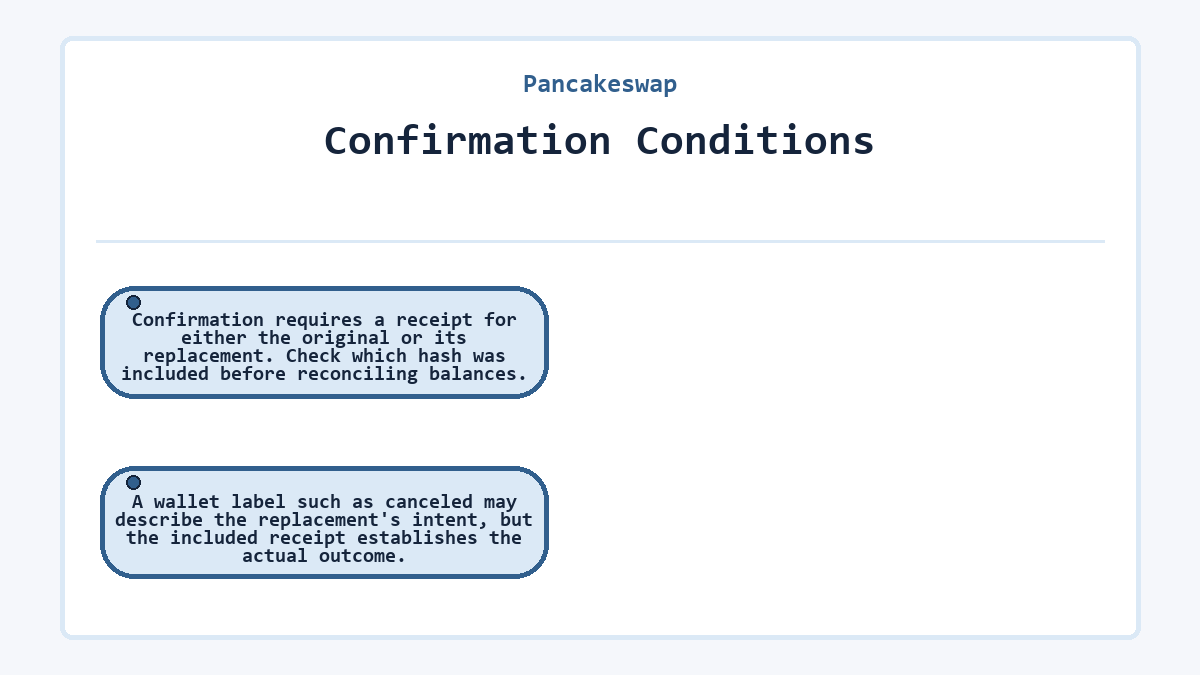
Confirmation requires a receipt for either the original or its replacement. Check which hash was included before reconciling balances. A wallet label such as canceled may describe the replacement's intent, but the included receipt establishes the actual outcome.
Reverted Transactions
A reverted transaction changes no intended protocol state, although it normally consumes network gas for the attempted execution. A prior approval can remain active because it was a separate successful transaction. Requoting may be necessary after price, liquidity, deadline, or slippage conditions change, but raising slippage does not fix every failure and increases the acceptable execution range.
Partial Crosschain and Order Outcomes
A partial outcome preserves completed stages and leaves the unresolved stage visible. Crosschain routes may leave an intermediate asset on one chain, while time-weighted orders may have filled only some scheduled portions. Recovery starts from the asset and status already present. Restarting from the original input ignores the completed state and can duplicate exposure.
The Final Exit Boundary
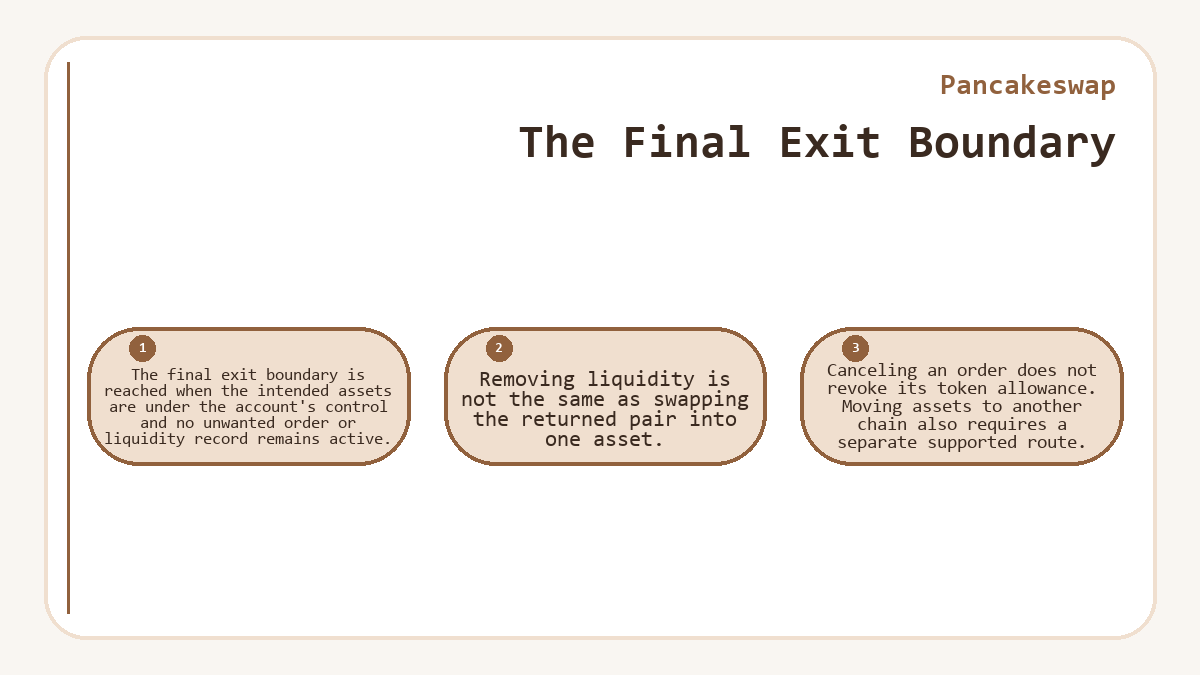
The final exit boundary is reached when the intended assets are under the account's control and no unwanted order or liquidity record remains active. Removing liquidity is not the same as swapping the returned pair into one asset. Canceling an order does not revoke its token allowance. Moving assets to another chain also requires a separate supported route.
Keep transaction hashes, order identifiers, token contracts, and gas amounts with the reconciliation record. A public address and transaction hash are enough to inspect on-chain history; no troubleshooting process needs a seed phrase or private key. After the records agree, any remaining allowance becomes a separate permission decision. Exiting the Pancakeswap action ends that protocol state, not the market or custody risks attached to the assets now held.
Key questions about Pancakeswap
Which Transaction Details Belong in a Reconciliation Record?
Keep the network, wallet address, transaction hash or order identifier, block timestamp, token contract addresses, actual token deltas, and native gas cost. For crosschain activity, add the source, bridge, and destination records. This set preserves what was signed, what settled, and where any unresolved asset remains without relying on a changing portfolio valuation.
Why Can the native-token Balance Drop More Than Expected After a Swap?
Network gas is paid in the chain's native token, so that balance may fall even when another token funded the swap. If the native token was also sold, subtract both the traded amount and the receipt's gas cost from the starting balance. A quoted output does not include this separate wallet-level change.
Does a Reverted Swap Leave Its Token Approval Active?
A reverted swap can leave an earlier token approval active because the approval and swap are separate transactions. The revert rolls back the failed swap call, not a previously confirmed allowance. Check the allowance independently and reduce or revoke it only if continued spending permission no longer matches the intended use.
When Does Replacing a Pending Transaction Cancel the Original?
Replacement takes effect when a transaction from the same account with the same nonce is included in the canonical chain first. The included transaction consumes that nonce, preventing the other version from executing there. A higher fee improves priority under some network conditions, but it does not itself prove replacement until a receipt exists.
What Happens If a Crosschain Destination Swap Cannot Finish?
The bridged intermediate asset may remain on the destination chain when bridging succeeds but the final swap fails. Inspect the route status and destination balance before submitting anything else. A source-chain success does not identify the final asset, and repeating the full route could transfer another input amount.
Where Do Uncollected V3 Fees Remain After a Partial Withdrawal?
Uncollected V3 trading fees remain associated with the non-fungible liquidity position until they are collected through the applicable position action. Removing only part of the liquidity does not by itself prove every fee was collected. Reconcile the remaining liquidity and fee fields separately before treating the position as fully exited.
What Wallet Information Is Safe to Use When Tracing a Missing Result?
A public wallet address and transaction hash are sufficient to inspect an on-chain transaction and its token movements. A route or order identifier may also help with staged activity. A seed phrase or private key is never required for this check, and disclosing either would give another party control over the wallet.
Updated on