 Pancakeswap
 Connects Wallet Actions to Quotes, Liquidity, and On-Chain Results
Pancakeswap links a connected wallet to spot swaps, crosschain routes, liquidity positions, and eligible farming actions. Each job depends on the selected network, token contract, available liquidity, native gas balance, and live route shown before signing. An AMM quote remains provisional until the wallet submits the transaction and the network confirms it. A signed-order quote remains provisional until the order fills and settles. The receipt, resulting balance, position record, or open-order status provides the evidence needed before another action.
Bottom line: Check the network, token contract, route, costs, and expected on-chain result before approving any Pancakeswap action.
Supported Actions and Their Dependencies
Supported work follows several execution paths, each with different inputs and completion records. A wallet connection identifies the account, but the selected product determines what the wallet must approve and sign.
Spot and Crosschain Trading
Spot swaps exchange tokens through AMM pools, market makers, or PancakeSwap X signed orders when the selected network, pair, and trade size support those routes. For AMM routes, the router may divide a trade across pools or use several hops when those paths improve the quote. Crosschain swaps add a bridge stage and may include swaps on the source chain, destination chain, or both. Available assets and routes change with liquidity, provider capacity, and network support.
Liquidity and Farming
Liquidity provision deposits assets into a pool and creates a record of the provider's share or configured position. Depending on the network and farm design, eligible positions may be staked for CAKE emissions or earn configured farm rewards while active without staking. Pool trading fees and Farm rewards are separate earnings streams, and neither removes exposure to changing token prices, inactive ranges, or smart-contract risk.
Orders and Derivatives
Limit orders wait for qualifying execution conditions, while time-weighted average price orders divide an order into scheduled portions. A target price does not guarantee a fill. Perpetual markets use separate collateral, margin, funding, and liquidation rules, so their position state cannot be reconciled like a wallet-to-wallet spot swap.
Quote Terms That Change the Outcome
Quote details describe both the proposed route and the conditions under which it may execute. Price impact estimates how the order interacts with available liquidity. Slippage tolerance sets the maximum accepted movement before execution, while minimum output states the least the contract should deliver under the quoted conditions.
A route can include several pools, fee tiers, and intermediate tokens. Split routing divides the input between paths, whereas multihop routing passes through intermediate assets. Disabling either option can produce a less favorable quote or leave no executable route. The live route matters more than assumptions based on the pair name alone.
Wallet, Network, and Token Identity
Wallet state supplies the starting record for every action. The account must hold the input asset on the selected network and enough of that network's native token for gas. A matching ticker or logo does not prove token identity. For a token, its chain-specific contract or mint address must match the intended asset. A native asset must match the selected network.
On allowance-based networks, a token approval grants the named smart contract permission to spend up to the approved amount, while the swap still requires separate confirmation. The allowance may remain after a trade until it is reduced, exhausted, revoked, or expires under its authorization rules. A connection or signature request never requires a recovery phrase or private key, so any prompt asking for either should be rejected.
Swap Execution From Quote to Settlement
A swap begins with an input token, output token, amount, and route quote. Before signing, the relevant checks are the token contracts, balance, pool route, trading fee, price impact, slippage setting, and minimum received. On allowance-based networks, a separate approval may be required when the router or other named spender lacks sufficient allowance for the input token.
For an AMM route, the wallet submits a separate swap transaction after any approval. Its identifier and confirmation record show whether the network accepted the state change or reported a failure. PancakeSwap X instead uses a signed order when available, so the wallet does not submit the swap itself as an on-chain transaction. A successful status should be reconciled with the output balance and event details. An interface success message without the expected receipt or balance does not complete that check.
Crosschain Completion States
Crosschain execution can include a source-chain swap, a bridge transfer, and a destination-chain swap. Each stage creates a different possible stopping point. Transaction history should show which chain currently holds the value, which asset reached that point, and whether another route stage remains pending.
A failure before the source transition may leave or return the original asset on the source chain. A bridge-stage failure follows the selected provider's refund process. If the destination swap fails after bridging succeeds, the wallet may receive the bridged intermediate asset instead of the requested output. Repeating the entire action before identifying that state can create an unintended second transfer.
Liquidity Position and Farm States
Liquidity records differ by exchange version and pool design. The position type controls ownership evidence, fee handling, range behavior, and the steps required to exit.
V2 Pool Shares
A V2 deposit produces fungible liquidity provider tokens representing a share of the pool. The position spans the pool's full price curve, and trading fees accrue within the pool share. Removing liquidity redeems the share for the underlying assets at the pool's current ratio, which may differ from the original deposit ratio.
V3 and Infinity Liquidity Positions
V3 and Infinity CLAMM positions use non-fungible records for liquidity within selected price ranges. A V3 position also belongs to a selected fee tier. Infinity LBAMM liquidity is fungible within each discrete price bin, while Infinity StableSwap positions use fungible pool tokens across the full curve. A concentrated liquidity position earns trading fees only while the pool price remains within its selected range. An out-of-range concentrated position can become concentrated in one asset. V3 fees require a separate claim rather than automatic reinvestment. Infinity LBAMM fees remain in active bins and are included when liquidity is withdrawn, while Infinity StableSwap liquidity stays active across its full curve.
Farm Reward States
Farm rewards depend on the network and farm design. Eligible V2 or V3 positions in supported EVM Farms can be staked for CAKE emissions. Infinity Farms and Solana V3 Farms instead accrue configured rewards to active positions without staking. Withdrawing a staked LP token or position requires unstaking, although supported V3 workflows can adjust liquidity while the position remains staked. Claimable rewards, unclaimed pool fees, and deposited liquidity remain separate amounts.
Costs, Routing, and Minimum Output
Total cost can contain network gas, pool trading fees, bridge-provider charges, and token-level transfer fees. Price impact is an execution effect rather than a separate invoice. Each pool hop may apply its own fee, so the route details provide the relevant amount for the proposed trade.
Minimum output connects the quote to contract enforcement. A tighter tolerance rejects more price movement and may increase failed attempts during volatile conditions. A wider tolerance accepts a broader execution range and can reduce the amount ultimately received. Raising tolerance does not repair missing liquidity, a blocked token transfer, or an invalid contract route.
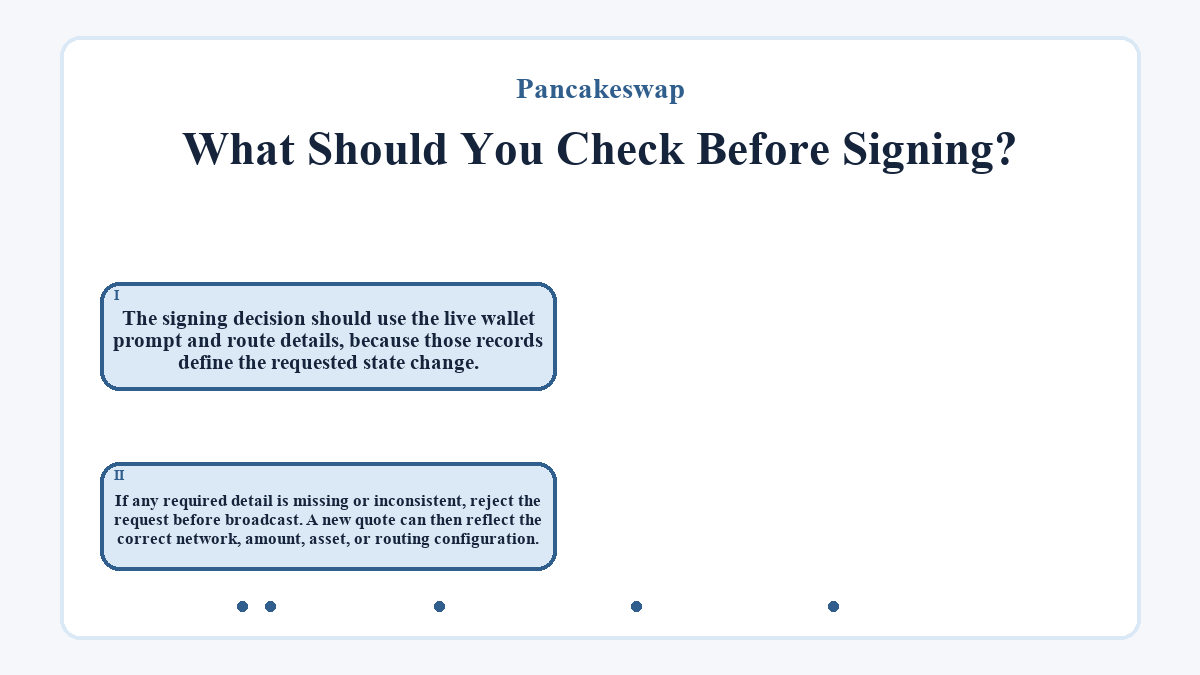
What Should You Check Before Signing?
The signing decision should use the live wallet prompt and route details, because those records define the requested state change.
- Confirm the selected network and connected wallet address.
- Match each token's contract or mint address to the intended asset, and verify any native asset against the selected network.
- When the selected route requires an on-chain approval or execution, keep enough native currency for its network fees.
- Review the route, fees, price impact, and minimum output.
- Match the wallet prompt to the intended contract or program, action, and amount.
If any required detail is missing or inconsistent, reject the request before broadcast. A new quote can then reflect the correct network, amount, asset, or routing configuration.
Failed, Pending, and Partial Results
Recovery depends on the recorded transaction state. A revert, an unconfirmed transaction, and a confirmed transaction with a missing wallet display require different responses.
Reverted Transactions
On EVM networks, a revert means the network executed the call but rejected its state change. Low liquidity, price movement beyond tolerance, expired quote conditions, insufficient gas balance, or token transfer restrictions can cause it. Gas already used is not returned. The error and route should be diagnosed before increasing tolerance or submitting the same call again.
Pending Transactions
A pending transaction has entered the network but lacks final confirmation. On EVM networks, its hash, nonce, and gas terms help show whether a later transaction from the same account must wait. Other networks expose different identifiers and replacement rules, so use the wallet's chain-specific status. Where supported, replacement or cancellation is a wallet-level network action, and neither guarantees success because the original transaction may confirm first.
Missing Wallet Displays
A confirmed output may not appear when the wallet is viewing another network or has not imported the token contract. The receipt, recipient address, contract address, and transfer events distinguish a display problem from an execution problem. Crosschain actions also require checking the destination chain and any intermediate asset recorded there.
Recovery Boundaries and Exit Records
Recovery starts with durable records: wallet address, chain, transaction or order identifier, confirmation status, asset identifiers, and resulting balances. For an on-chain action, no transaction identifier usually means the request was never broadcast. An approval receipt proves an allowance change, not a completed swap. A confirmed swap cannot be reversed by the interface.
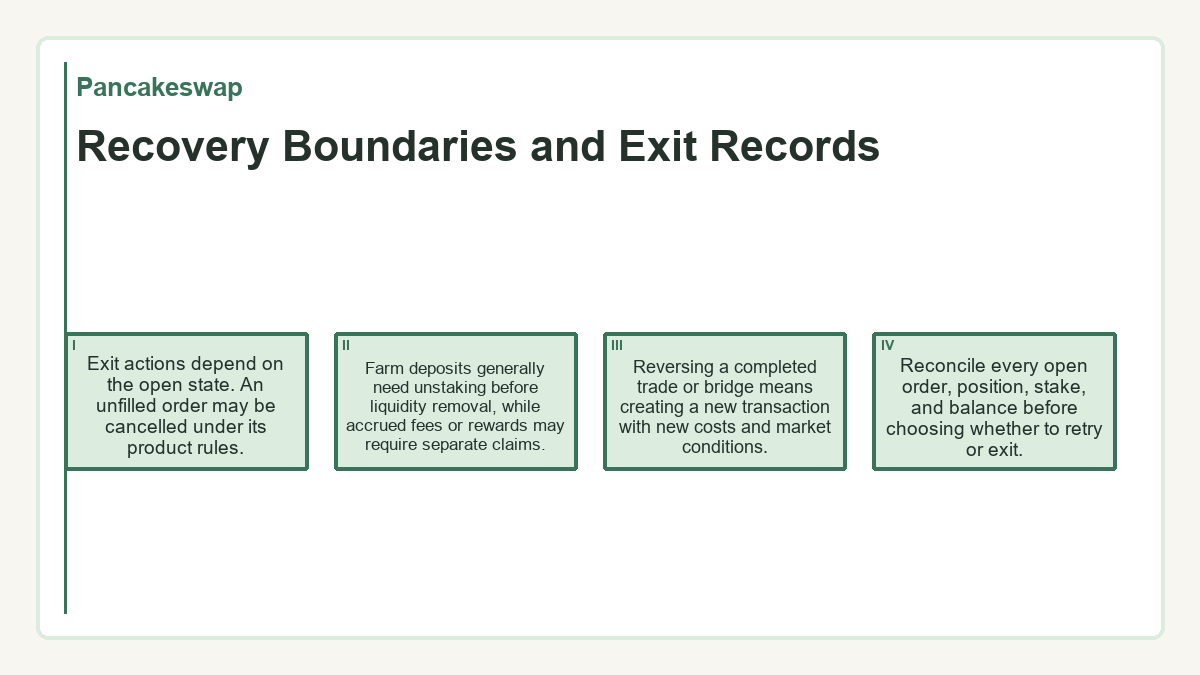
Exit actions depend on the open state. An unfilled order may be cancelled under its product rules. Farm deposits generally need unstaking before liquidity removal, while accrued fees or rewards may require separate claims. Reversing a completed trade or bridge means creating a new transaction with new costs and market conditions. Reconcile every open order, position, stake, and balance before choosing whether to retry or exit.
Practical questions about Pancakeswap
Does a Higher Slippage Setting Reduce the Trading Fee?
No, slippage tolerance does not reduce the pool fee or network cost. It widens the range of prices the transaction may accept before reverting. The route determines trading fees, while network demand determines gas. A wider tolerance may improve execution probability, but it can also permit a lower output amount.
When Should a Token Approval Be Revoked?
An approval can be revoked when the contract no longer needs permission to spend the token or when the approved amount exceeds the intended use. Revocation is a separate on-chain transaction and requires network gas. It changes future spending permission but cannot reverse a transfer already confirmed by the network.
Why Can a Token Be Bought but Not Sold?
A token may lack enough exit liquidity, charge a transfer fee the route cannot accommodate, or contain contract restrictions blocking sales from some addresses. Increasing slippage only changes acceptable price movement. It cannot bypass a prohibited transfer, create liquidity, or correct a token contract selected by mistake.
Where Do V3 Trading Fees Appear?
V3 trading fees accrue to the individual liquidity position rather than automatically increasing its deposited liquidity. They can be reviewed and claimed from the position record. An out-of-range position stops earning new trading fees, although fees accrued while the position was active remain separate from the underlying liquidity.
Will Disconnecting a Wallet Cancel an Open Order or Pending Transaction?
No, disconnecting the interface does not cancel an order already created or a transaction already broadcast. The network or order system continues processing its recorded state. Reconnect the same wallet on the correct network to inspect it. Cancellation or replacement, when supported, requires another signed action and may use gas.
Updated on